Description
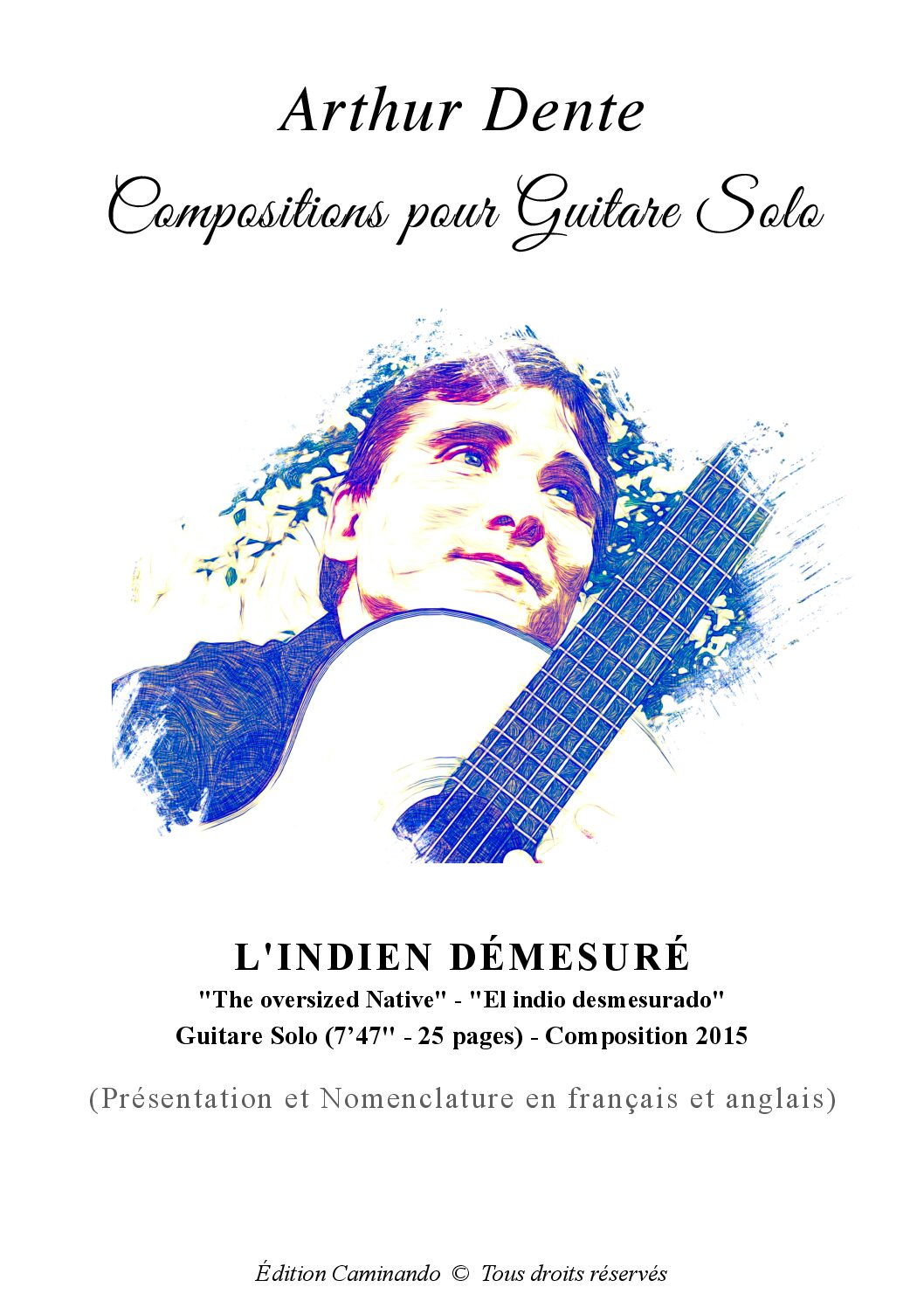
L’INDIEN DÉMESURÉ
« The oversized Native » – « El indio desmesurado »
Guitare Solo (7’47″) – Composition 2015
Existe en versions Guitare & Flûte et Guitare, Choeur & Orchestre.
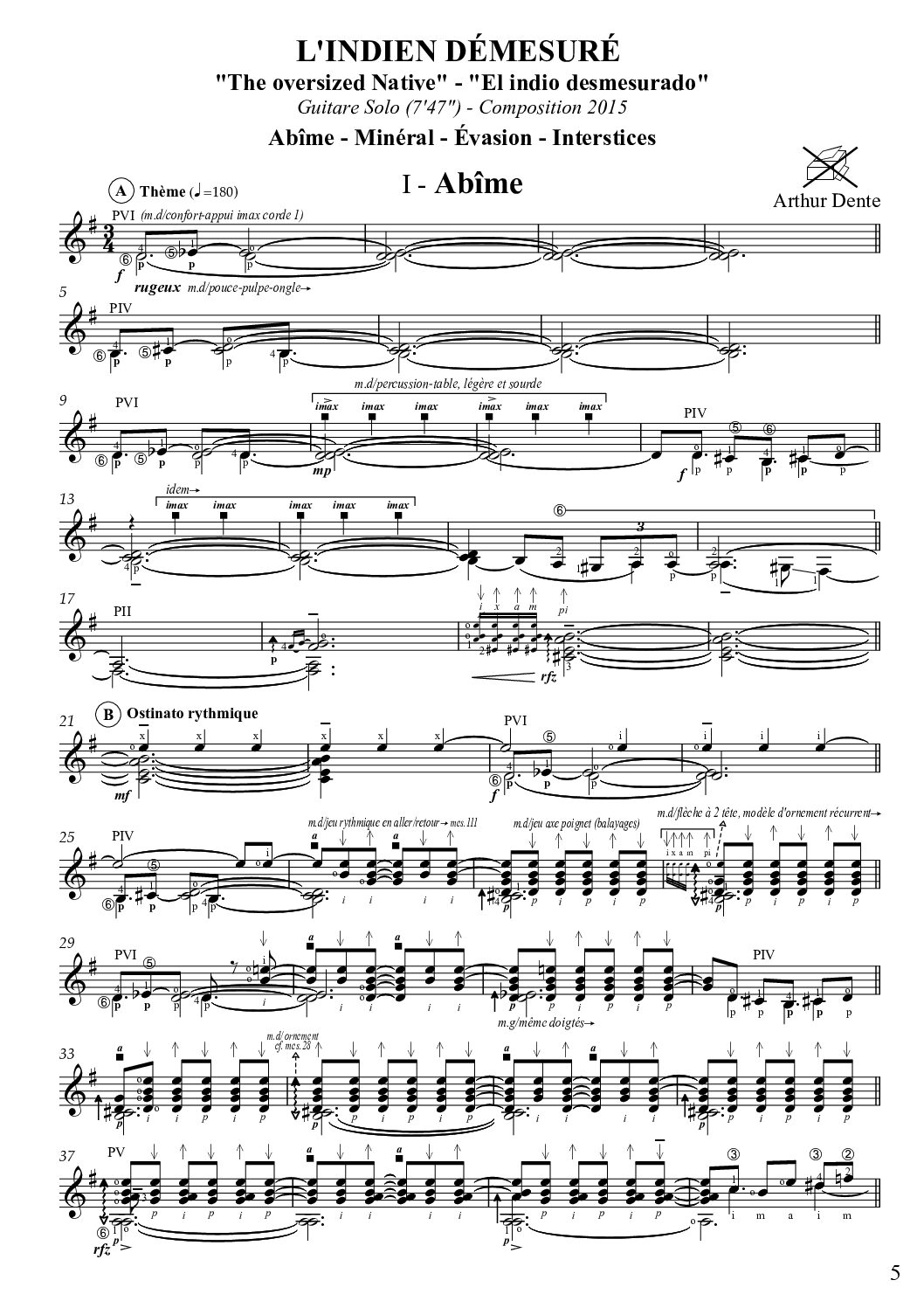
I. Abîme
II. Minéral (page 5 mes.113)
III. Évasion (page 9 mes.234)
IV. Interstices (page 11 mes.311)
Inspiration poétique :
Une pièce d’écriture contemporaine, exposant un processus de catharsis au travers de ses quatre
mouvements. De la dure obscurité caverneuse, froide et humide des deux premiers mouvements
(Abîme et Minéral), vers la douce lumière baignant une nature oxygénée, dans ses deux derniers
mouvements (Évasion et Interstices). Voici les deux grands blocs de cette forme sonore : comme
deux piliers reliés entre eux par une arche servant de communication et d’échange; de cette
collaboration nait la catharsis avec son parcours initiatique salutaire.
Abîme : Exposition du thème qui va irriguer la pièce, dans le grave et dans la nuance forte.
Pulsation et harmonie sont encore absentes puis un espace sonore se crée, une harmonie dissonante
s’installe, une pulsation et une carrure se précisent.
L’impression d’une instabilité ne favorisant aucune polarité tonale caractérise ce motif qui
représente le danger, la part inhumaine et incontrôlable de l’être. Une référence au monde trouble
des affects, mais aussi une métaphore sonore de forces souterraines ayant une dimension sacrée
mais monstrueuse et terrifiante à la fois. Ce thème initial martelé de façon obsessionnelle installe le
chaos sonore de ce premier mouvement.
Minéral : Ce second mouvement a pour rôle de montrer le travail de purification par un fluide.
L’être y est absent, on évolue dans un univers sonore qualifié de minéral, figurant une eau
ruisselante et résonnante sur les anfractuosités de la roche. Des cavités et des sinuosités introduites
par l’emploi de 2 gammes aux échelles différentes. Cette alternance d’arpèges et de gammes se
double d’une alternance régulière de carrures à 3/4 puis 2/4, qui intensifient la métaphore d’une
eau purificatrice ruisselant sur une roche qui lui imprime son rythme.
Loin d’être le fruit du hasard, ce terrain changeant qui modifie l’itinérance de l’eau est lié à la
notion physique de gravité, qui impose l’idée de sens et de vérité. Ici se joue, dans le secret de l’eau,
la catharsis salvatrice.
Évasion : L’arcade servant de voûte porteuse, le point de bascule où la pièce rejoint son second
versant. L’articulation charnière entre deux mondes, celui des profondeurs obscures représentant
un mal absolu, et celui du retour à une surface ensoleillée, représentant la liberté et les beautés
d’une nature retrouvée. Plus qu’un nouvel éclairage, c’est une renaissance, un nouveau départ, une
nouvelle vie, construite comme un antidote, à partir des éléments musicaux fondateurs de la pièce.
Interstices : Soudain la masse sonore semble disparaître jusqu’au silence. L’enchaînement de trois
notes chromatiques rappelant le thème initial identifié comme étant un danger, mais ici réduit à
l’image d’un mal enfin dévitalisé, un motif évanescent présenté dans la nuance pianissimo, dans
l’aigu et en valeurs plus longues. Ce second pilier de l’œuvre, bien que semblant être construit de
vide, serait l’équivalent énergétique du premier pilier, mais la gravité massive se serait transformée
en un monde spacieux et libéré de contraintes.
L’indien démesuré-Guitare solo-Arthur Dente 1/ 2 2
Intérêt technique :
– Recherche de timbres spécifiques dans le jeu du pouce main droite avec trois positions d’attaques
permettant trois sonorités, sous les qualificatifs de : rugueux, neutre et sombre, (précisions
techniques dans la nomenclature qui suit).
Dans cette pièce, le pouce main droite tient un rôle mélodique essentiel, choisi pour sa puissance et
sa prédilection dans le jeu des basses. (au début, à l’énoncé du thème, puis dans les mesures, 149-194
/ 209-217 / 234-273).
– Gestuelle main droite spécifique, empruntée au jeu andalou, permettant l’accompagnement
rythmique par balayage de cordes tout en dégageant les parties mélodiques au pouce et autres doigts
(essentiellement dans le premier mouvement Abîme). L’utilisation simultanée de légères percussions
(golpes), apporte une poly-fonctionnalité à la main droite, (une technique de jeu très fréquente dans
la guitare andalouse).
– Utilisation à la main gauche d’enchaînements harmoniques andalous spécifiques, non employés
dans la littérature pour guitare classique, (mes.189-208 / 220-233).
– Recherche sur les résonances, avec des positions main gauche utilisant le pouce et permettant les
unissons et mouvements chromatiques entre plusieurs cordes, (dernier mouvement Interstices,
mesure 311 à fin).
– Recherche sur les modes, entre autres : gammes ton-demi-ton et tons-entiers, notamment dans les
second et troisième mouvements, Minéral (mes. 113) et Évasion (mes. 234).
–1) Utilisation de différentes mesures : ternaires, binaires et asymétriques à 5/8 et 5/4 (mes. 327-350).
——————————————————
Les titres évocateurs des mouvements et des sous-parties sont issus des textes écrits par l’auteur,
utilisés dans la version chantée de cette pièce pour guitare, choeur et orchestre.
Un ouvrage d’analyse musicale de cette oeuvre existe.
Enfin, bien que dans les grandes lignes les indications de doigtés, de nuances, de tempi et autres
signes d’interprétation soient justifiables, ces paramètres ne sont que des propositions qui peuvent/
doivent être amovibles, interchangeables ou remplacées selon la personnalité de l’interprète ou
suivant l’inspiration du moment. Une attitude que l’auteur s’applique à lui-même, l’essentiel étant
d’obtenir une cohérence narrative dans une esthétique contrôlée.
————————————————————-
2
L’indien démesuré-Guitare solo-Arthur Dente/ 1 2
L’INDIEN DÉMESURÉ
« The oversized Native »
Solo Guitar (7’47″) – Composed in 2015
Also available in versions for Flute and Guitar and for Guitar, Choir and Orchestra.
I. Abyss
II. III. IV. Mineral (p. 5, m. 113)
Escape (p. 9, m. 234)
Interstices (p. 11, m. 311)
Poetic Inspiration
A contemporary work that unfolds a process of catharsis through its four movements. From the
harsh, cavernous darkness—cold and damp—of the first two movements (Abyss and Mineral), the
music gradually progresses toward the gentle light bathing an oxygen-rich natural world in the
final two movements (Escape and Interstices). These are the two great structural blocks of the work:
like two pillars connected by an arch that serves as a channel of communication and exchange.
From this interaction emerges catharsis, together with its beneficial initiatory journey.
Abyss : The opening movement presents the principal theme that permeates the entire work, stated
in the lower register and at a forte dynamic. At first, pulse and harmony are absent; gradually, a
sonic space emerges, a dissonant harmonic field takes shape, and both pulse and formal structure
become increasingly defined. A sense of instability, favouring no tonal centre, characterises this
motif, which represents danger and the inhuman, uncontrollable dimension of being. It evokes the
turbulent world of the affects while also serving as a sonic metaphor for subterranean forces whose
nature is at once sacred, monstrous, and terrifying. Obsessively hammered out, this initial theme
establishes the sonic chaos that dominates the first movement.
Mineral : The role of the second movement is to depict a process of purification through the agency of
a fluid element. Human presence is absent; instead, the listener is immersed in a mineral soundscape,
suggesting water trickling and resonating through the fissures and irregularities of rock formations.
Cavities and winding pathways are evoked through the use of two scales of differing intervallic
structures. The alternation of arpeggios and scales is reinforced by a regular alternation of 3/4 and
2/4 metres, intensifying the metaphor of purifying water flowing across rock, whose contours impose
their rhythm upon it. Far from being arbitrary, this shifting terrain—which continually redirects the
course of the water—is linked to the physical notion of gravity, suggesting direction, meaning, and
truth. Here, within the secret workings of water, the work’s redemptive catharsis quietly unfolds.
Escape : The arch that functions as a supporting vault: the pivotal point at which the work reaches its
second slope. It serves as the hinge between two worlds—the dark depths symbolising absolute evil, and
the return to a sunlit surface embodying freedom and the beauty of a rediscovered nature. More than a
mere change of perspective, this movement represents a rebirth: a new beginning, a new life, conceived
as an antidote and constructed from the very musical materials that gave rise to the work itself.
Interstices : Suddenly, the sonic mass appears to dissolve into silence. A succession of three chromatic
notes recalls the initial theme, previously identified with danger; here, however, it has been reduced to
the image of an evil finally deprived of its vital force. The motif becomes evanescent, presented
pianissimo, in the upper register, and in longer note values. This second pillar of the work, though
seemingly constructed from emptiness, may be understood as the energetic counterpart of the first.
The massive force of gravity has been transformed into a spacious world liberated from constraint.
The oversized native-Solo Guitar-Arthur Dente 3/ 2 2
Technical Features
Exploration of specific tone colours in right-hand thumb technique, using three points of attack
that produce three distinct timbral qualities, described as rough, neutral, and dark (technical
details are provided in the nomenclature)
In this work, the right-hand thumb assumes a fundamental melodic role, chosen for its power and
its natural affinity with bass-line playing (at the opening statement of the theme, and in mm. 149–
194, 209–217, and 234–273).
A specific right-hand technique derived from Andalusian guitar playing is employed, allowing
rhythmic accompaniment through string-sweeping gestures while simultaneously bringing out
melodic lines with the thumb and the other fingers (primarily in the first movement, Abyss). The
simultaneous use of light percussive effects (golpes) further enhances the multifunctional role of
the right hand, a technique frequently encountered in Andalusian guitar performance.
Use of specific Andalusian harmonic progressions in the left hand, not commonly found in the
classical guitar repertoire (mm. 189–208 and 220–233).
Exploration of resonance through left-hand positions involving the thumb, enabling unisons and
chromatic motion across multiple strings (final movement, Interstices, mm. 311 to the end).
Exploration of modal resources, including whole-tone and octatonic (whole-step/half-step)
scales, particularly in the second and third movements, Mineral (m. 113) and Escape (m. 234).
Use of contrasting metric structures, including triple, duple, and asymmetrical metres in 5/8 and
5/4 (mm. 327–350).
––––––––––––––––––––––––––––––
The evocative titles of the movements and subsections are drawn from texts written by the composer and used
in the vocal version of this work for guitar, choir, and orchestra.
A separate volume devoted to the musical analysis of this work is available.
Finally, although the indicated fingerings, dynamics, tempi, and other performance markings are, in broad
terms, fully justified, they should be regarded as suggestions rather than prescriptions. They may—and
perhaps should—be modified, exchanged, or replaced according to the performer’s personality or the
inspiration of the moment. The composer adopts the same approach in his own performances, the essential
objective being the achievement of narrative coherence within a controlled aesthetic framework.
————————————————————
4
The oversized native-Solo Guitar-Arthur Dente
Avis
Il n’y a pas encore d’avis.