Description
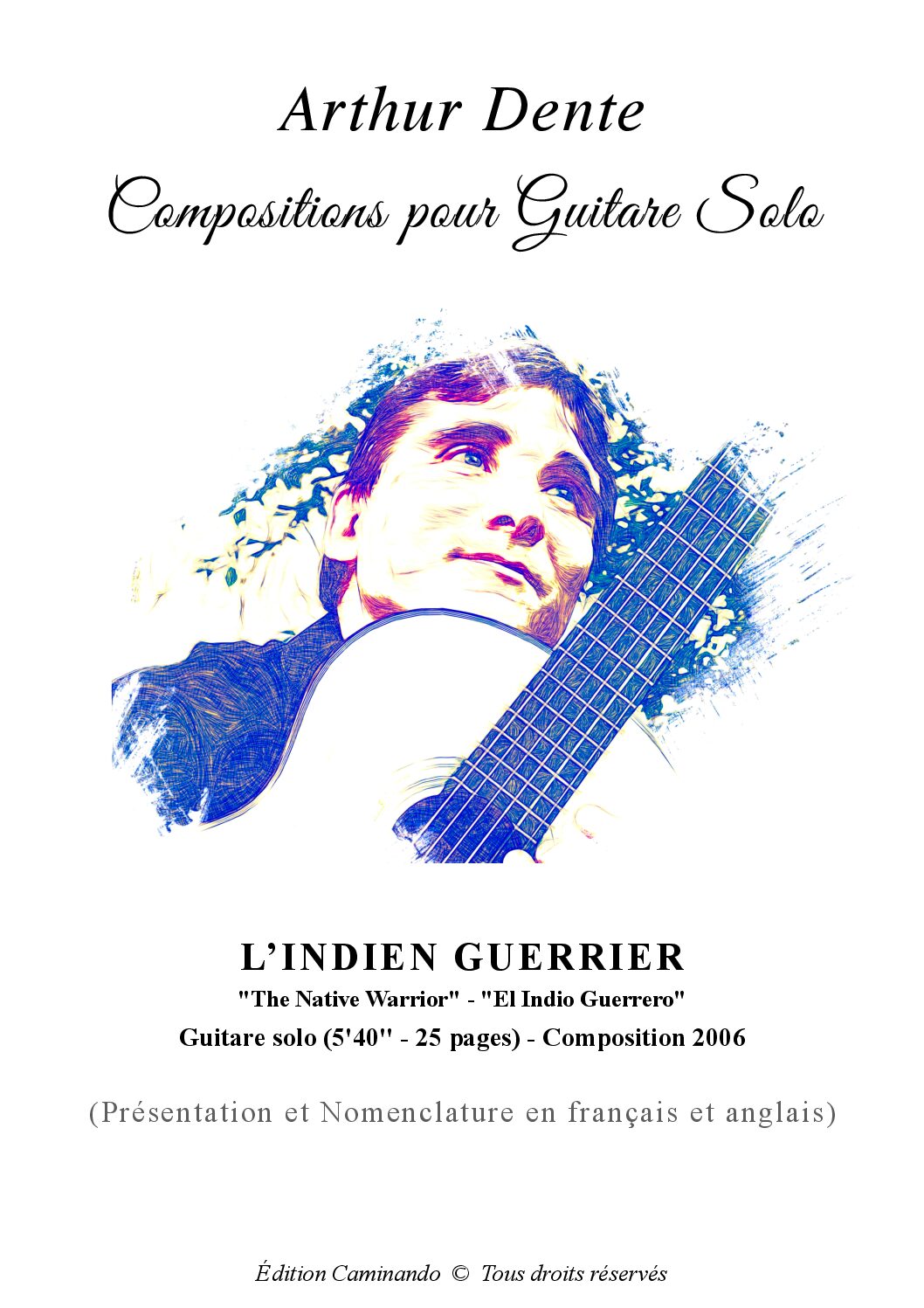
L’INDIEN GUERRIER
« The warrior native » – « El indio guerrero »
Guitare solo (5’40 ») – Composition 2006
Existe en versions Guitare & Flûte et Guitare, Choeur & Orchestre.
I. Profondeur des origines
II. III. IV. V. Terre des ancêtres (page 3 mes.67)
Divinités créatrices (page 7 mes.197)
Culte nocturne (page 10 mes.271)
Ancestrales racines (page 12 mes.339)
Inspiration poétique :
Toute la pièce est conçue sur une métaphore guerrière, impliquant l’idée d’une action soutenue
caractérisée par une pulsation mécanique et quasi obsessionnelle. Cependant, une trame de
nuances traverse de part en part l’œuvre, qui débute sur une seule note répétée, dans la nuance
piano, figurant le son du tocsin et nous prévenant d’un danger imminent. Chacun des cinq
mouvements présente une évolution figurative du thème guerrier, comme une nouvelle tactique de
combat.
Intérêt technique :
Cette pièce est entièrement construite sur la structure rythmique andalouse à 12 temps, qui apparaît
ici alternativement ou successivement sous trois formes :
– la première, présente 2 mesures à 3/4, suivies de 3 mesures à 2/4,
– la deuxième, présente deux séries de trois mesures à 2/4,
– la troisième, présente quatre mesures à 3/4 consécutives.
La pulsation est placée au devant et les premiers temps de chaque mesure doivent être légèrement
accentués. La configuration mélodique suit également ces appuis afin de restituer la forme interne
des trois structures rythmiques à 12 temps. Chaque portée musicale est structurée en 12 temps.
Bien que le tempo employé corresponde au tempo de la Buleria traditionnelle, la structure
harmonique est toute autre, essentiellement axée sur le premier degré du ton originel Mi mineur,
souvent présenté sans sa tierce. L’idée étant de conserver une polarité tonale quasi unique, forte et
martiale, correspondant à la thématique guerrière utilisée ici.
La main droite présente une gestuelle issue de la guitare andalouse avec divers balayage de cordes,
les rasgueados avec ou sans pouce, la technique de l’alzapúa au pouce seul et le jeu mélodique en
appuyé. Cet ensemble de gestes permet la fluidité dans l’accompagnement harmonique des lignes
mélodiques. Il s’agit aussi de donner à la guitare la possibilité d’orchestrer plusieurs plans sonores à
la fois, dans une dynamique rythmique soutenue.
———————————————————
Les titres évocateurs des mouvements et des sous-parties sont issus des textes écrits par l’auteur,
utilisés dans la version chantée de cette pièce pour guitare, choeur et orchestre.
Enfin, bien que dans les grandes lignes les indications de doigtés, de nuances, de tempi et autres signes
d’interprétation soient justifiables, ces paramètres ne sont que des propositions qui peuvent/doivent être amovibles,
interchangeables ou remplacées selon la personnalité de l’interprète ou suivant l’inspiration du moment. Une attitude
que l’auteur s’applique à lui-même, l’essentiel étant d’obtenir une cohérence narrative dans une esthétique contrôlée.
L’indien guerrier-Guitare solo-Arthur Dente 1/ 1 1
L’INDIEN GUERRIER
« The Warrior Native »
Solo Guitar (5’40 ») – Composed in 2006
Also available in versions for Flute and Guitar and for Guitar, Choir and Orchestra.
I. Depths of the Origins
II. III. V. Land of the Ancestors (p. 3 m.67)
Creator Deities (p. 7 m.197)
IV. Nocturnal Ritual (p. 10 m.271)
Ancestral Roots (p. 12 m.339)
Poetic Inspiration
The entire work is conceived as a martial metaphor, embodying the idea of sustained action driven
by a mechanical, almost obsessive pulse. Yet a subtle web of nuances runs throughout the piece. It
opens with a single note repeated softly (piano), evoking the sound of an alarm bell and warning of
an imminent danger. Each of the five movements presents a figurative development of the martial
theme, as though introducing a new combat strategy.
Technical Aspects
This work is entirely built upon the Andalusian twelve-beat rhythmic structure, which appears here
alternately or successively in three different forms:
• the first consists of two bars of 3/4 followed by three bars of 2/4;
• the second consists of two consecutive groups of three bars of 2/4;
• the third consists of four consecutive bars of 3/4.
The pulse is placed in the foreground, and the first beat of each bar should be slightly accented. The
melodic configuration likewise follows these points of emphasis in order to reveal the internal shape of
the three twelve-beat rhythmic structures. Each musical system is organized around a twelve-beat cycle.
Although the tempo corresponds to that of the traditional Bulería, the harmonic structure is of a
very different nature, being primarily centered on the tonic degree of the original key of E minor,
often presented without its third. The intention is to preserve a strong, almost unique tonal polarity,
martial in character and consistent with the work’s underlying warrior theme.
The right hand employs gestures derived from Andalusian guitar technique, including various string
sweeps, rasgueados with or without thumb participation, the alzapúa technique performed with the
thumb alone, and melodic playing with apoyando stroke. Together, these techniques provide fluidity
in the harmonic accompaniment of the melodic lines. They also enable the guitar to orchestrate
several simultaneous sound layers while maintaining a sustained rhythmic momentum.
———————————————————
The evocative titles of the movements and subsections are drawn from texts written by the composer and used in the
vocal version of this work for guitar, choir, and orchestra.
Although the fingering indications, dynamics, tempi, and other performance markings are, in their broad outlines,
fully justified, they should be regarded only as suggestions. According to the performer’s personality or the
inspiration of the moment, they may—and sometimes should—be modified, interchanged, or replaced.
The composer applies this principle to his own performances as well. The essential objective is to achieve a coherent
musical narrative within a controlled aesthetic framework.
2
The warrior native-Solo Guitar-Arthur Dente
Avis
Il n’y a pas encore d’avis.